Executive Summary
Premisys and Accenture demonstrated an agentic predictive maintenance workflow for industrial environments at Accenture’s Houston Innovation Hub. Running on Intel-powered edge infrastructure, the Premisys Agentic AI platform analyzed real-time drill-press sensor data, detected abnormal vibration, and enabled operators to investigate conditions through dashboards and natural-language interaction.
The demonstration shows how local sensing, Intel-optimized edge inference, machine-learning analytics, and an AI assistant can work together to shorten the path from an equipment signal to operator understanding and action. The on-premises configuration supports the latency, resiliency, and data-control requirements common in industrial operations, while creating a foundation for agents to connect operational events with maintenance history, work orders, engineering documentation, and other enterprise information. As the architecture evolves, enterprise AI models such as Anthropic’s Claude can provide a reasoning layer across these distributed sources, helping operators investigate what happened, understand the broader operational context, and determine appropriate next actions while time-sensitive detection remains at the edge.
The next step is to validate the workflow on production equipment against customer-defined reliability, operational, and business KPIs.
“The opportunity in Industrial AI isn't simply detecting an anomaly. It's shortening the distance between a signal, understanding what it means, and taking the right action. That's the pattern we're validating through the Houston Innovation Hub.”
Demo Purpose and Setup
The demo simulates equipment monitoring in process industries such as food and beverage, energy, oil and gas, utilities, chemicals, and natural resources. Its purpose is to show how sensor data can support earlier investigation and maintenance decisions, helping reduce equipment failures and production losses.
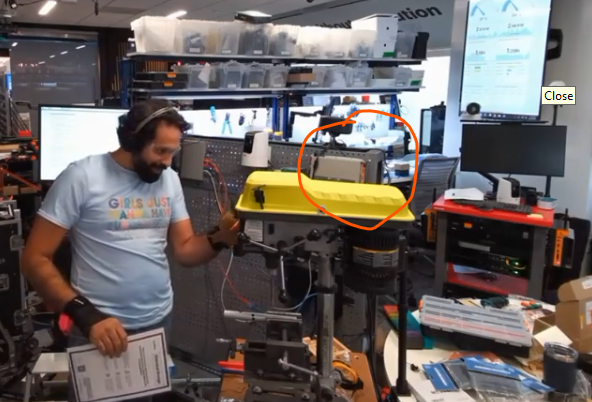
A three-axis vibration and temperature sensor on the drill press streams real-time data to the Intel edge server (Figure 1). The demo compares four operating states: idle, air drilling (moving the spindle without contacting material), wood drilling, and metal drilling. Metal drilling represents the high-vibration condition intended to trigger an alert, while the other three states are treated as normal, making this a controlled demonstration of anomaly detection for predictive maintenance.
 View full-size image (opens in a new tab)
Premisys Workflow
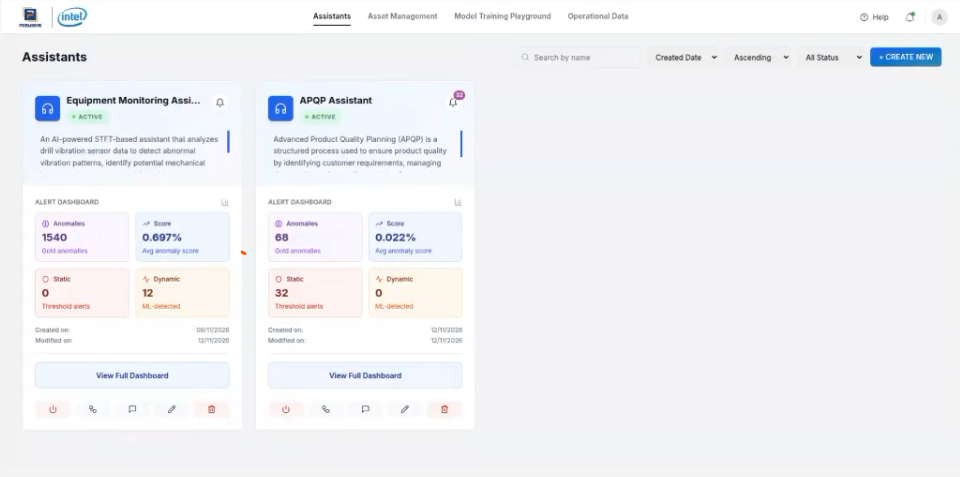
A purpose-built Equipment Monitoring Assistant (Figure 2) implements the workflow through Premisys’ drag-and-drop workflow builder. The assistant connects data ingestion and anomaly detection with alert review, dashboard display, operator queries, and asset status.
 View full-size image (opens in a new tab)
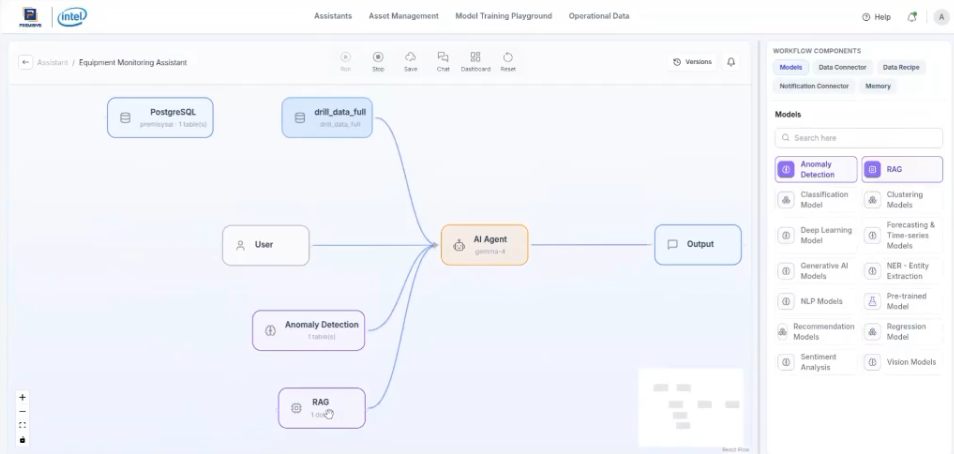
Workflow Builder links these functions into a configurable sequence, allowing the team to inspect incoming data and review the resulting alerts (Figure 3). Sensor readings, which represent the OT data, are captured in a local database and prepared for processing by the Equipment Monitoring Assistant. The AI agent accesses IT data through connectors.
 View full-size image (opens in a new tab)
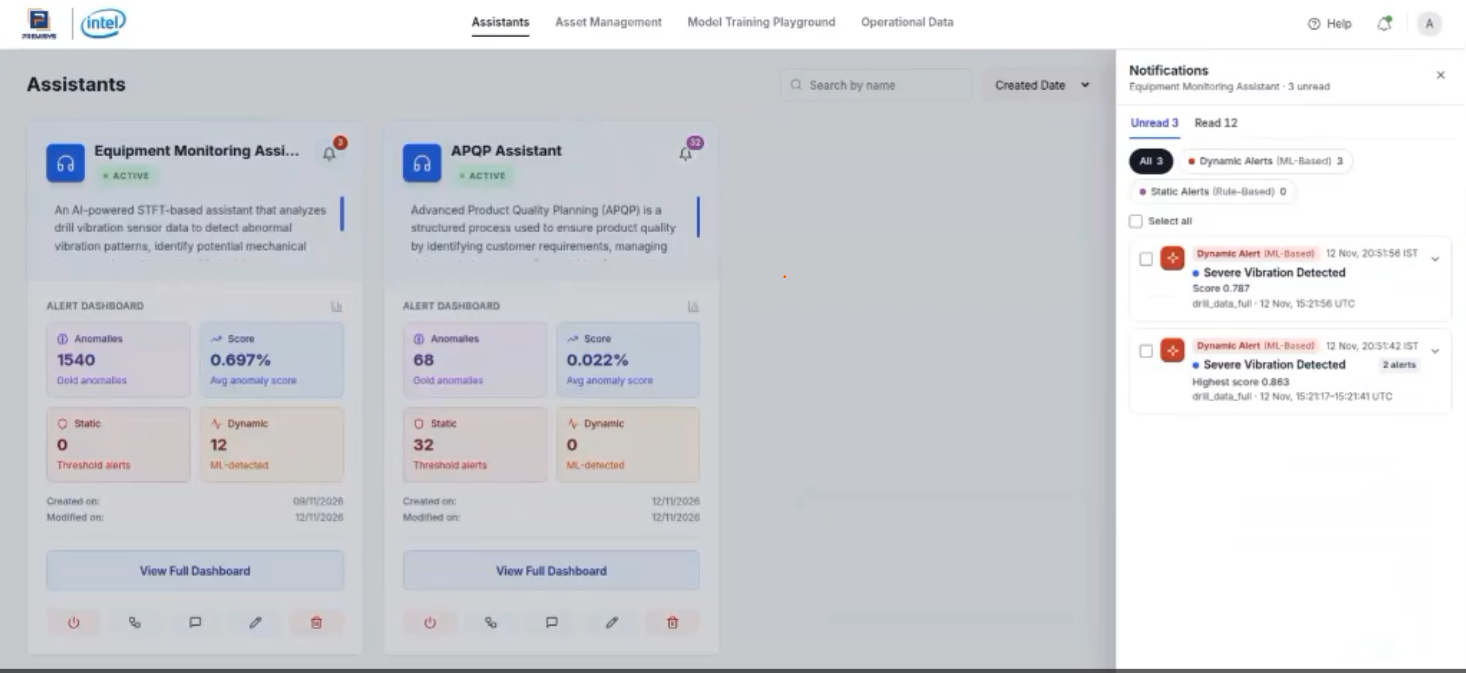
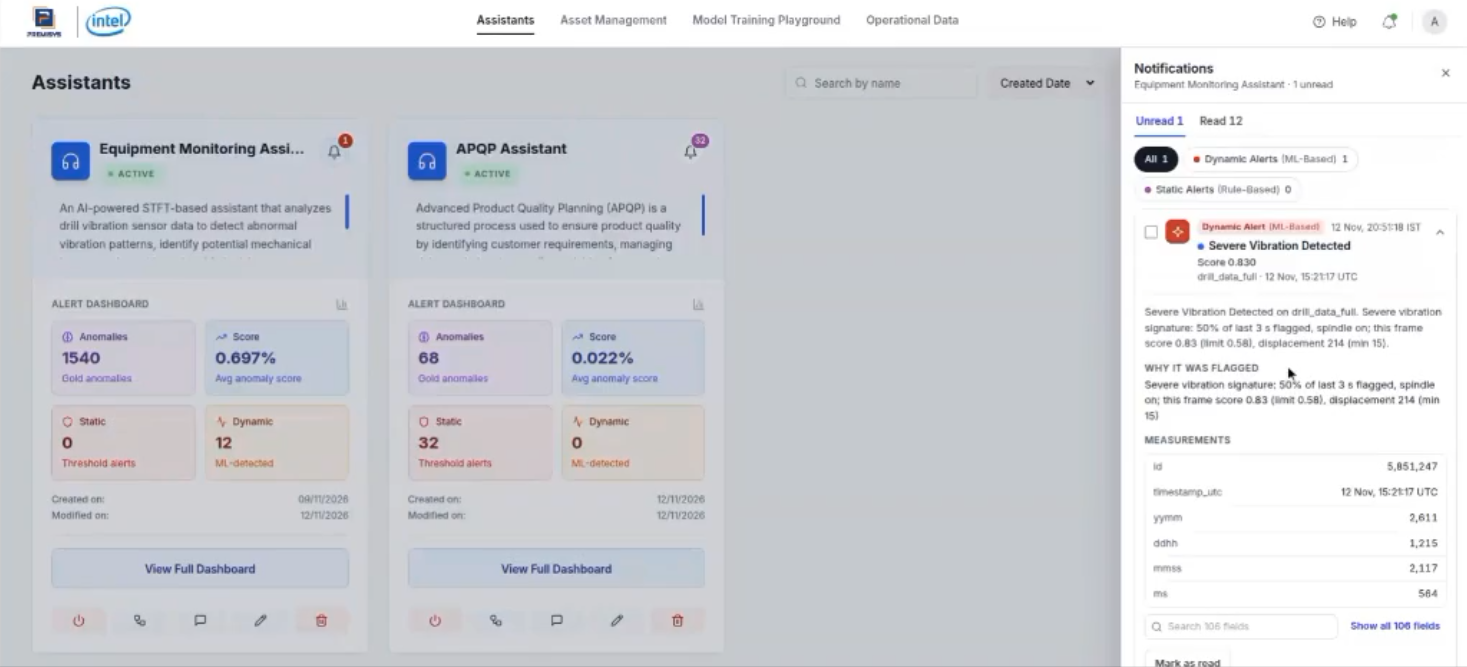
Anomaly detection: The detector uses a machine-learning model trained on fingerprints derived from short-time Fourier transforms (STFT) of streaming sensor data (Figure 4). By analyzing vibration patterns and energy levels across four sensor channels, it distinguishes metal drilling from the normal operating states (idle, air drilling, and wood drilling). Incoming fingerprints are compared against two reference databases, and the resulting scores are smoothed over approximately two seconds. An alert is triggered when at least half the frames in a three-second window exceed the detection threshold and the spindle has been running for at least four seconds; only one notification is sent per detection event (Figure 5). In controlled testing, the frequency-domain approach produced more consistent detection performance with no false detects than the evaluated time-domain approach.
 View full-size image (opens in a new tab)
 View full-size image (opens in a new tab)
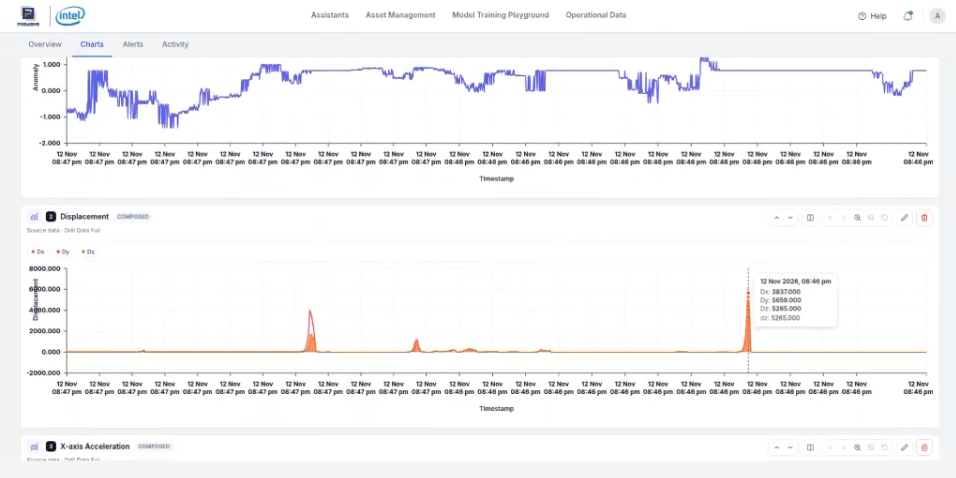
Dashboard and Alert Management: A graphically configurable dashboard displays live sensor data, anomaly scores, and other relevant information (Figure 6). Alert management summarizes detected anomalies and allows operators to inspect the supporting details.
 View full-size image (opens in a new tab)
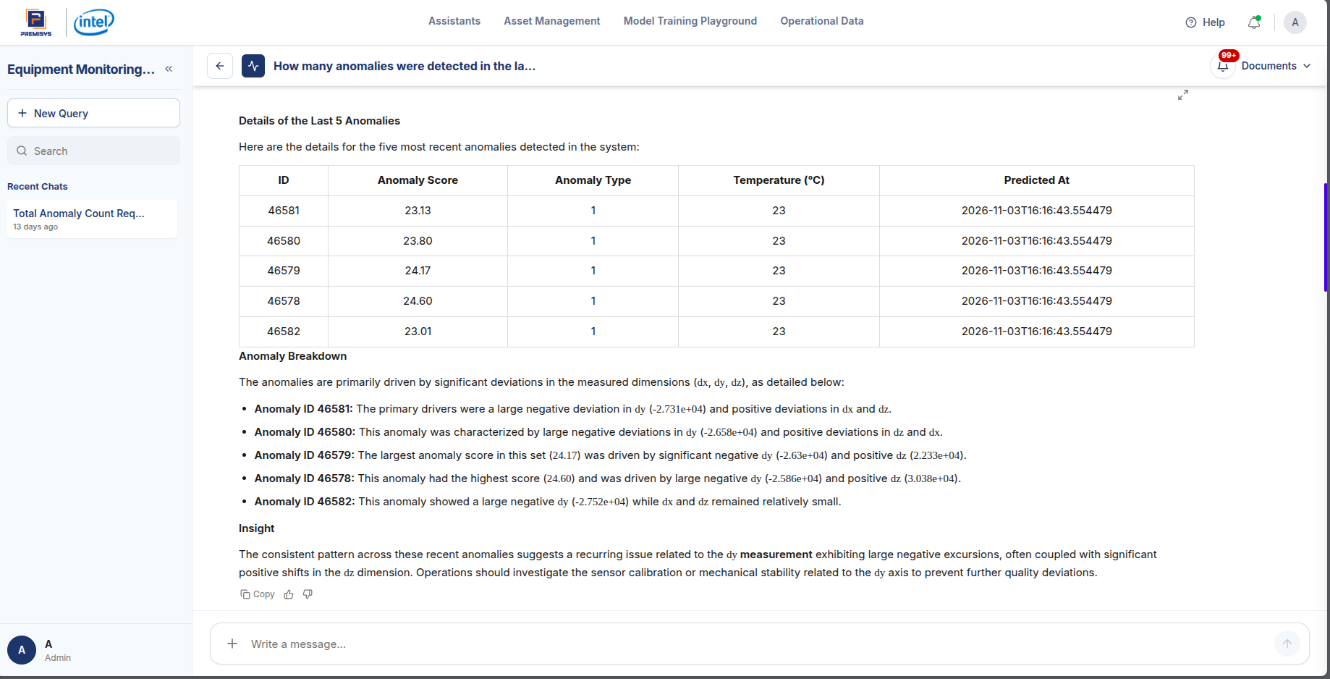
Operator queries and insights: An AI agent uses a domain-specific, fine-tuned small language model (SLM) to answer questions about alerts and support investigation. Retrieval-augmented generation (RAG) provides relevant context, while a Model Context Protocol (MCP) and tool-calling layer connects the agent to other data sources. The demo illustrates how an operator can review recent anomalies and request an explanation in natural language (Figure 7). The agent also provides insights and suggests actions for the operator.
 View full-size image (opens in a new tab)
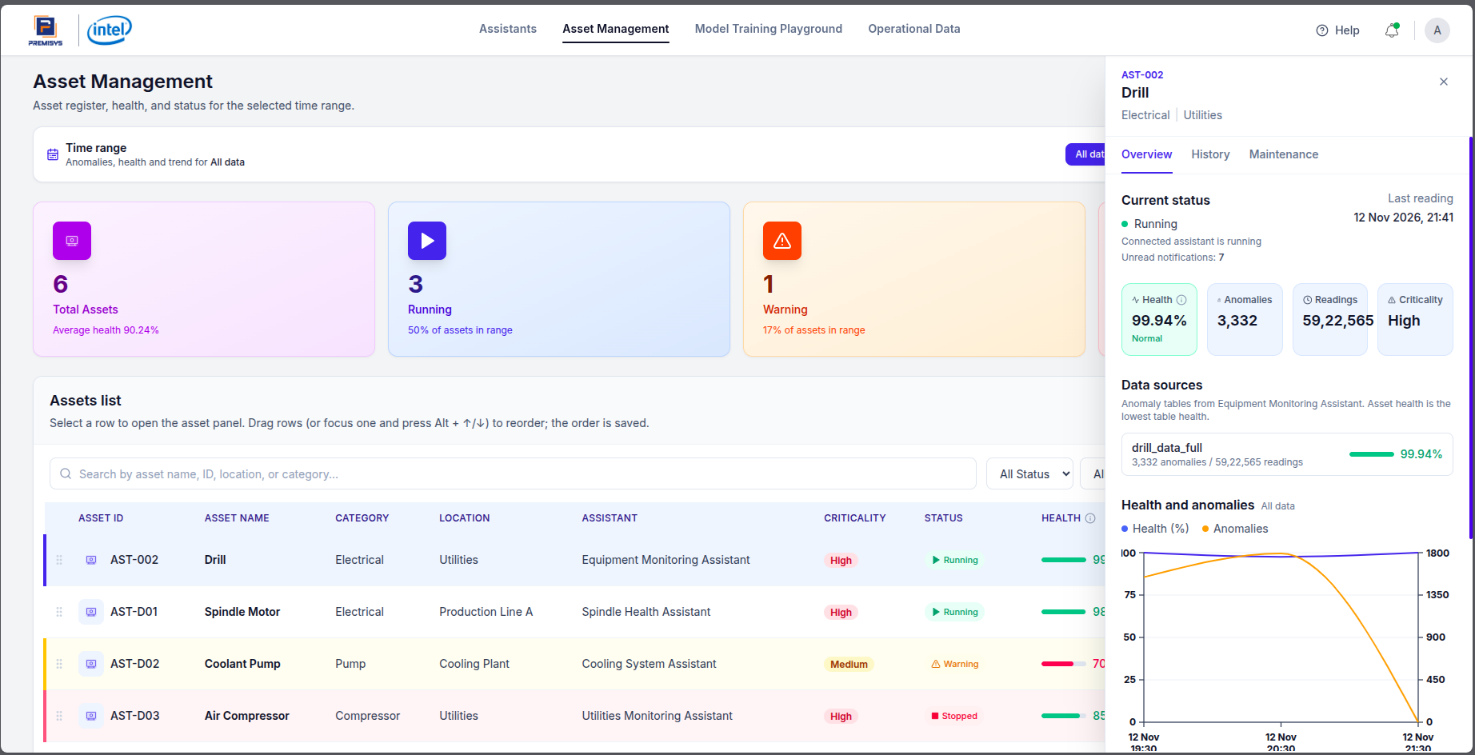
Asset management: The asset management screen brings together asset status and health indicators (Figure 8). The status details for the Drill asset show how high-vibration alerts have affected its health.
 View full-size image (opens in a new tab)
Edge AI Architecture
The solution runs on premises on an Intel® Core™ Ultra Series 3 processor-based edge system with a Intel® Arc™ Pro B70 discrete GPU. Premisys deployed OpenVINO 2026.0.0.0 with the Optimum Intel toolkit to optimize inference performance across the workload. The software pipeline maps well to the CPU of up to 16 cores, a significantly enhanced GPU with up to 128 execution units, and a power-efficient NPU, all within a 45W to 65W power envelope. The architecture supports multi-model AI execution, orchestration, data processing, and data movement close to the equipment, where latency, connectivity, resiliency, and data sovereignty can influence workload placement
This edge foundation can support a broader class of agentic industrial applications. Edge-resident models can handle time-sensitive machine detection, while enterprise-grade AI models such as Anthropic’s Claude can provide higher-order reasoning across maintenance records, work orders, engineering documents, and business systems. Anthropic’s Model Context Protocol (MCP), together with governed tool calling, provides a path for agents to access these distributed tools and information sources while preserving the role of edge infrastructure for workloads that need to remain close to the equipment.
Business Value
Detecting an abnormal condition is only the beginning of predictive maintenance. Operators must still understand what changed, determine whether intervention is warranted, and connect the decision to maintenance and operational processes.
By combining real-time sensor analytics, Intel-powered edge inference, anomaly detection, asset context, and natural-language interaction, the Premisys workflow demonstrates a path toward compressing the time between signal, investigation, and action. Extending this pattern with enterprise AI models such as Anthropic’s Claude creates an opportunity to reason across both industrial signals and the enterprise information surrounding an asset, including maintenance history, engineering documentation, work orders, and business systems.
In production environments, this pattern could help improve maintenance responsiveness, reduce avoidable downtime, and make specialized operational knowledge more accessible to frontline teams.
The next step is production validation. Premisys and Accenture, powered by Intel, intend to identify client equipment with a recurring, measurable reliability problem and evaluate the workflow against customer-defined KPIs. The configuration can first be validated in a sandbox using synthetic data, then adapted to customer equipment and connected to operational and enterprise data for a pilot.