Manufacturing AI: Frequently Asked Questions
Learn how manufacturers can use AI to investigate production problems, support maintenance and quality teams, and make better use of existing operational data.
What is manufacturing AI?
Manufacturing AI uses production data, machine signals, business records, and operational knowledge to help teams identify problems and improve decisions. Applications include detecting equipment anomalies, investigating quality deviations, forecasting production, and understanding material consumption.
Its usefulness depends on the problem being addressed, the available data, and how the results fit into daily operations.
What does Premisys do?
Premisys provides an edge-centric AI platform for manufacturers. It connects operational and business data with analytical models and AI assistants to help teams investigate issues and identify actions.
Supported use cases include maintenance, quality, digital operations, and production forecasting. The scope of each deployment depends on the customer’s requirements and available data.
What is an AI agent in a manufacturing environment?
An AI agent can coordinate several steps to complete a defined task—for example, retrieve equipment data, run an analysis, consult a maintenance procedure, and present findings to an operator.
An agent’s permissions determine what it can access and execute. Providing a recommendation and changing a machine setting are separate capabilities that require different controls.
How is Premisys different from a general-purpose AI chatbot?
A general-purpose chatbot primarily responds to questions using its model and connected information sources. Premisys combines manufacturing data, domain-specific small language models, and analytical models to support operational workflows.
The language model helps users interact with information. Analytical models perform calculations, identify patterns, and generate predictions used in the response.
What is edge AI, and why use it in manufacturing?
Edge AI runs AI workloads close to the equipment or facility generating the data, rather than relying entirely on a remote cloud service.
Local processing can reduce network dependency and data movement, support faster responses, and give manufacturers greater control over operational information. The benefits depend on the application and deployment design.
Can Premisys run on-premise? Does it require the internet?
Premisys is designed for on-premise deployment. The application can process connected manufacturing data and run AI workloads within the customer’s environment.
Internet requirements depend on the configuration, including external integrations, remote support, and software updates. During deployment planning, we identify which functions operate locally and which require connectivity.
What data does Premisys need?
Data requirements depend on the use case. Examples include:
Equipment readings and operating history for maintenance analysis.
Process conditions and test results for quality analysis.
Production, inventory, and material-consumption records for operational analysis.
Procedures, manuals, and maintenance records for operator assistance.
An initial assessment determines whether the available data is sufficient and identifies gaps before the pilot begins.
Does Premisys replace our ERP, MES, SCADA, or historian?
Premisys is designed to work with existing systems, using their data to support analysis and operational decisions.
The integration plan defines which system remains the authoritative source for each type of information. Replacing an existing system is a separate scope decision.
How does Premisys work with AVEVA, Litmus, and Ignition?
Premisys can use these platforms as sources of industrial data for manufacturing AI applications.
AVEVA, Litmus, and Ignition provide different connectivity, data-management, and operational capabilities. Premisys adds analytical models and AI-assisted workflows using the connected information. Supported interfaces, software versions, licensing, and access requirements are confirmed for each deployment.
How does AI support maintenance and quality assurance?
For maintenance, AI can analyze equipment and process data to identify unusual behavior and help teams prioritize investigation. Preventive maintenance follows planned service intervals; predictive maintenance uses condition data to identify emerging problems.
For quality, AI can examine relationships between process conditions and measured outcomes to help teams investigate deviations. Predictions must be validated before they are used to change inspection or testing practices.
Does Premisys make decisions or control equipment automatically?
Premisys supports human decision-making by presenting analyses and recommendations. Automated actions, where included, must be explicitly configured and authorized.
The deployment scope defines what the system may recommend, what it may execute, and which actions require human approval.
How are AI recommendations checked?
Recommendations should be evaluated against source data, operating limits, established procedures, and the judgment of responsible plant personnel.
During a pilot, the customer and Premisys agree on validation criteria for the selected use case. Depending on the application, these may include prediction error, false alerts, missed events, response time, and the usefulness of recommendations.
How can we evaluate Premisys before a production deployment?
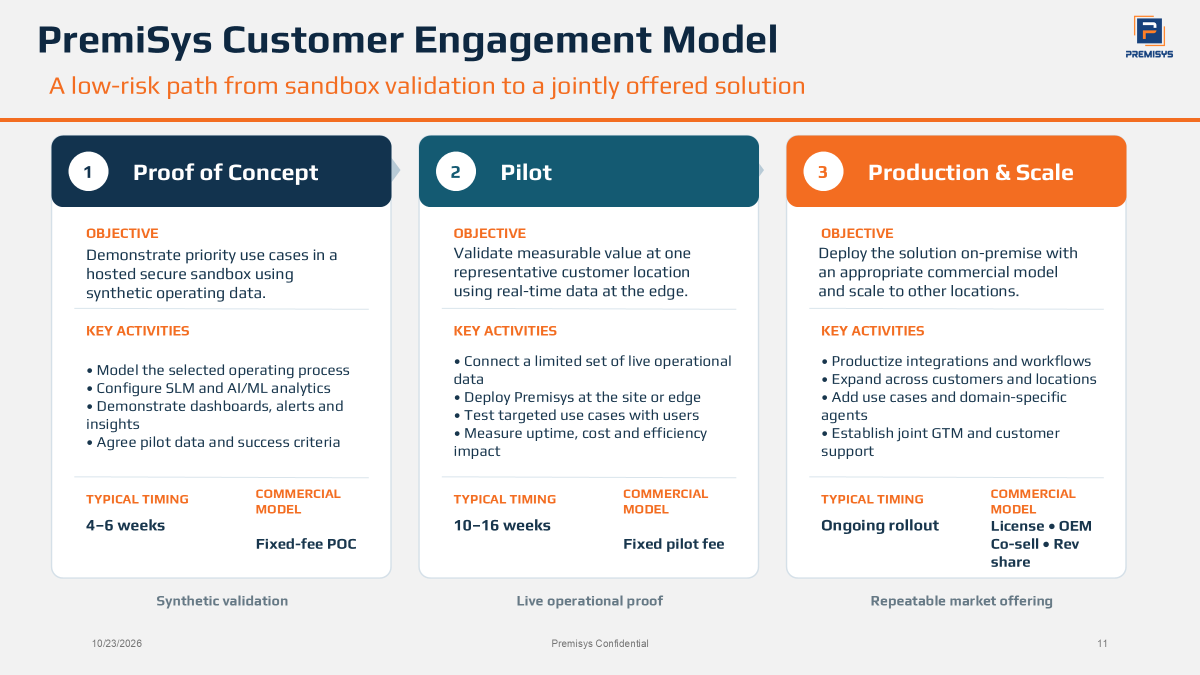
Premisys offers a staged evaluation process:
Proof of concept: Use a sandbox with synthetic data to explore the proposed workflow.
Pilot: Use customer data to assess performance, integration requirements, and potential business value.
Production: Deploy the agreed application with defined operating responsibilities and acceptance criteria.
A synthetic-data demonstration shows how a workflow operates. A real-data pilot is needed to evaluate its performance in the customer’s environment.
How should we measure the return on a manufacturing AI project?
Start with a baseline for one operational problem. Depending on the use case, measures may include unplanned downtime, scrap, ingredient consumption, quality deviations, forecast error, or time spent investigating issues.
Compare results over an agreed period and account for changes in production volume, product mix, and operating conditions. Include software, hardware, integration, and ongoing support costs in the assessment.
Has Premisys been deployed in food manufacturing?
Premisys has deployed its platform at Chitale, a snack-food manufacturer in India, for fryer-oil-usage intelligence and production forecasting.
The engagement provides an example of applying AI to production, inventory, and process data. Contact us to discuss the deployment and its relevance to your operations.
What determines pricing and deployment time?
Pricing and timing depend on the selected use cases, number of sites, data availability, integration requirements, hardware, and support scope.
An initial discovery discussion establishes the operational problem and deployment requirements. The proposal then defines deliverables, costs, responsibilities, and evaluation criteria.
How do we get started?
Choose one operational problem with a clear owner and a measurable outcome. Bring examples of the data and reports your team currently uses, along with any deployment or security requirements.
Request a discovery call to assess whether Premisys fits your use case.